Art & Technology
Before You Make Up Your Mind About AI
Why I use it, what worries me about it, and why the conversation has become too simple
Lately, I’ve noticed something strange.
Someone will react to a photo, a piece of music or a design I’ve made and tell me they like it. Then, sometimes minutes later, they’ll ask:
“Did you do that with AI?”
And suddenly it feels as though the answer is supposed to determine whether they were allowed to like it in the first place.
Sometimes the question is even blunter: “Did AI make this?”
My answer is simple:
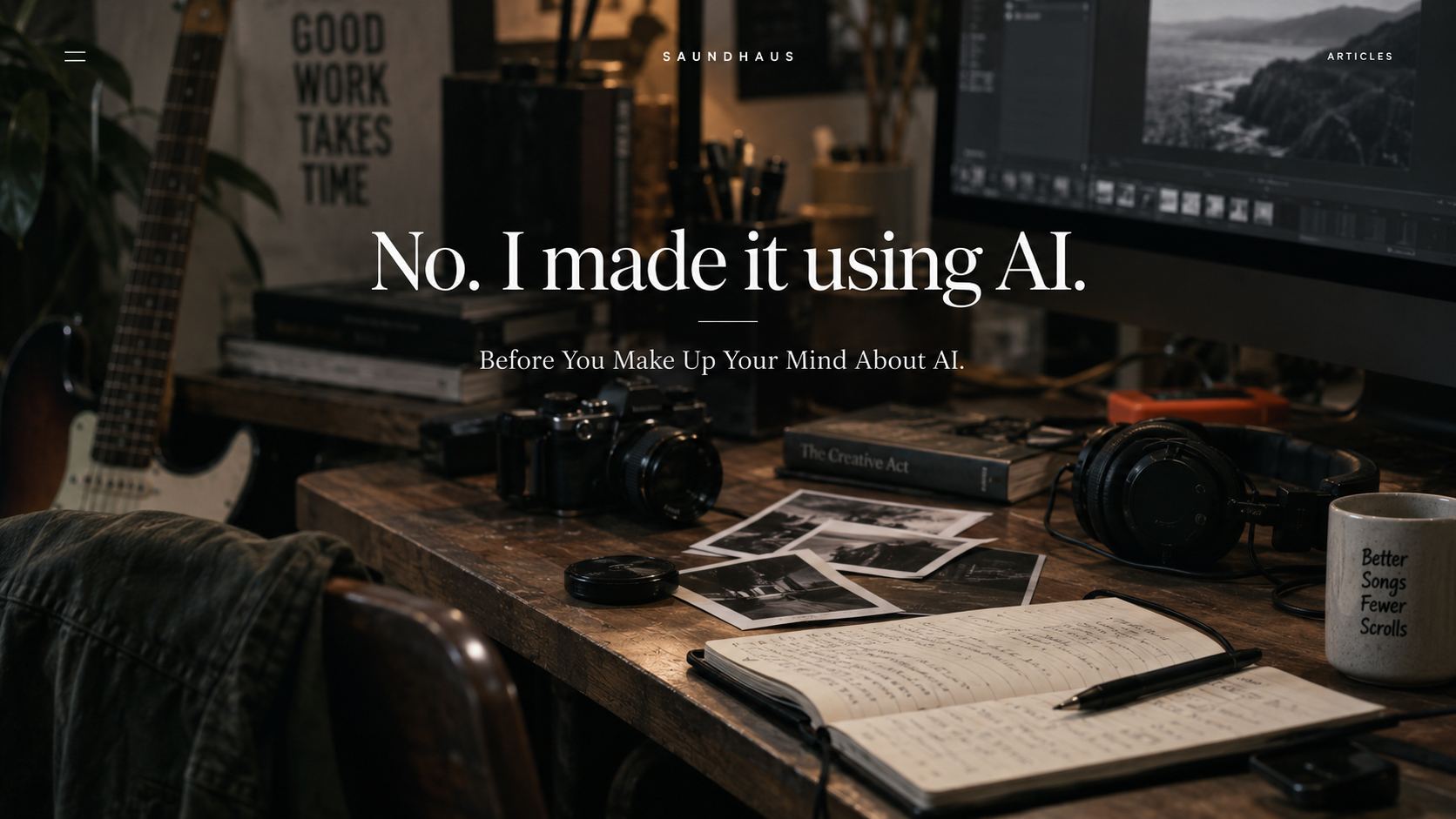
No. I made it using AI.
That distinction matters.
I’ve been a musician, composer, producer and graphic designer for decades. I was doing all of those things long before generative AI existed. Using a new tool doesn’t erase everything I knew before I picked it up, any more than Photoshop made graphic designers unnecessary or digital recording made musicians stop being musicians.
And no, AI isn’t involved in everything I do. Not even close. Most of my work still happens the way it always has. I use AI when it helps me solve a particular problem.
When AI Becomes a Verdict
The weird thing is that AI has somehow become a verdict instead of a tool.
A photograph gets labeled “AI Content.” Someone hears that an album cover involved AI and suddenly the music itself is suspect. Headlines say AI steals from artists, wastes water or is coming for everyone’s jobs, and eventually all of those separate concerns collapse into one reaction:
Ewww. AI.
Some of those concerns are legitimate. Artists have every right to question whether their work was used to train commercial systems without their consent. Deepfakes, impersonation and voice cloning can do real harm. Jobs will change. Some will disappear. There are environmental costs that deserve scrutiny.
I’m not interested in pretending none of that exists.
What bothers me is when every use of AI gets treated as though it were the same thing.
Makeup Was the Original AI
I sometimes joke that makeup was the original AI.
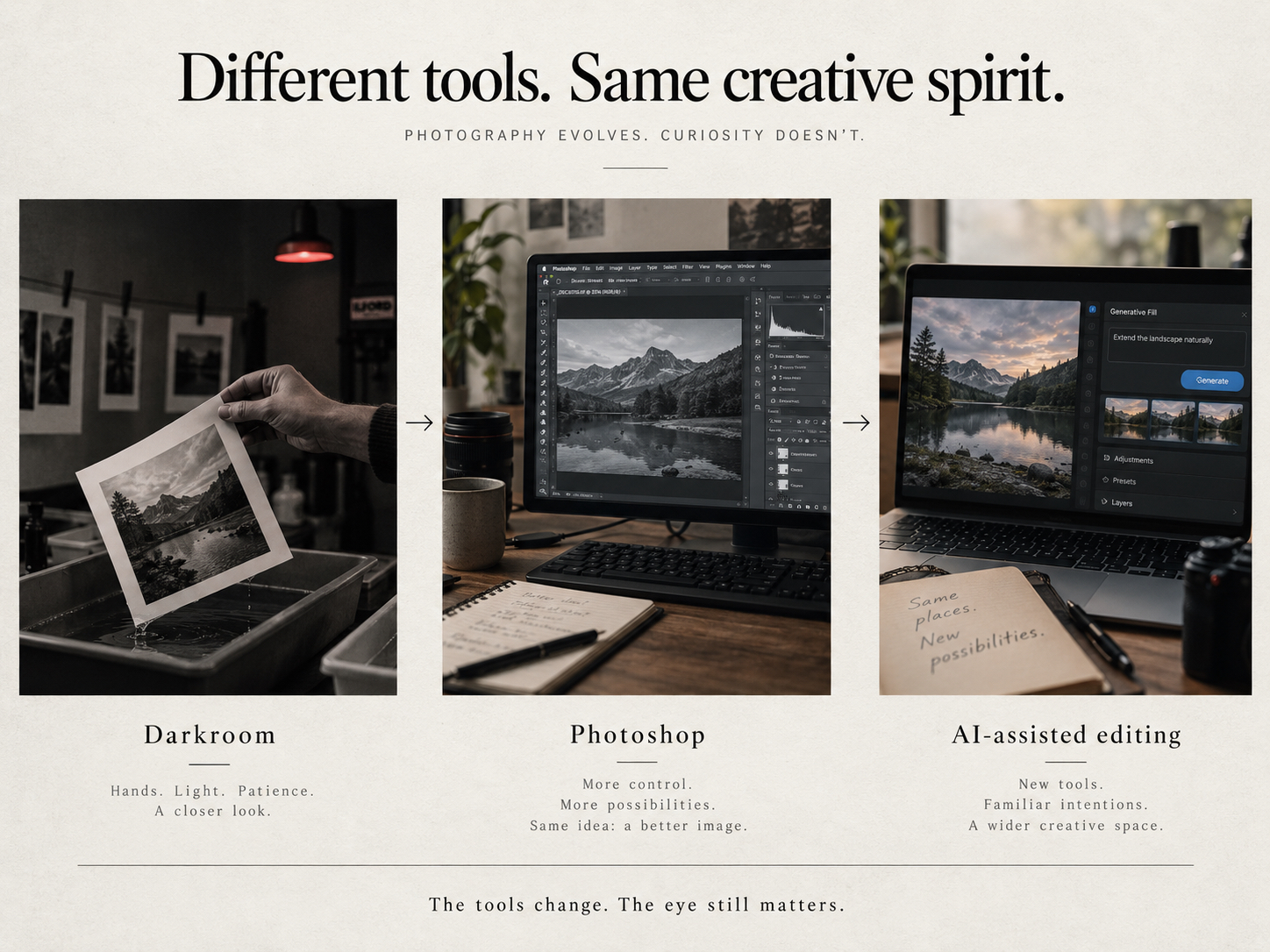
Obviously it wasn’t. But think about what we’ve always done to images. Makeup changes a face. Lighting changes it again. Photographers choose flattering lenses and angles. Darkroom photographers dodged and burned prints long before Photoshop showed up.
If I photograph a building and manually correct the exposure, straighten the perspective and remove something distracting in Photoshop, we call that photo editing.
If an AI tool performs those same corrections, some people suddenly call the photograph fake.
Why?
The letters A-I don’t tell you what actually happened to the picture.
The same thing happened with artwork for one of my albums. People became so focused on the fact that AI had touched the cover that the music almost became beside the point.
Eventually I thought: if you’re more interested in how the cover was made than whether the songs are any good, you’re probably listening for the wrong reason.
The Work Changes. The Experience Doesn’t Disappear.
AI has also changed how I approach some work simply because I’m older.
At 64, I’m not especially interested in rehearsing three nights a week for beer money just to prove I’m a “real” musician anymore.
I also don’t want to spend hours doing repetitive production work when I already know what I want the finished result to be.
Sometimes my role changes from doing every mechanical step myself to directing the process.
That doesn’t mean expertise disappears.
If I tell a tool to correct the perspective of a building without changing the architecture, I have to know when it gets the architecture wrong. If I ask it to improve a mix without destroying the dynamics, I have to know what good dynamics sound like.
A powerful tool doesn’t give someone taste.
It just gives them a more powerful tool.
“But AI Steals From Artists”
The “AI steals from artists” argument deserves more care than either side usually gives it.
Creative people have always learned from other creative people. Every musician I know carries around decades of influences. None of us invented the major scale, the twelve notes or the idea of putting three chords together.
But that doesn’t completely answer the concern about companies training commercial AI systems on enormous amounts of copyrighted work without asking the people who made it.
Those are two different questions.
So is asking an AI to clone someone’s voice.
So is asking it to reproduce a particular song.
So is using it to help straighten a photograph.
Lumping all of that together under “AI” doesn’t make the conversation clearer. It makes it harder to have the conversation at all.
A Sounding Board, Not a Ghostwriter
I use AI in songwriting sometimes, too, but probably not in the way people imagine.
If I’ve written a lyric that isn’t landing or a bridge that feels wrong, I may talk through the problem with an AI system much the way I would bounce an idea off another musician.
Usually I’m not asking it to write the song.
I’m asking:
“Why isn’t this working?”
That’s a sounding board, not a ghostwriter.
And if it gives me a bad answer, I throw the answer away.
That part still belongs to me.
Ask What Actually Happened
So when somebody asks, “Did AI make this?” I think they’re asking the wrong question.
Ask what the person actually did with it.
Ask whether anyone was copied, deceived or harmed.
Ask how much of the creative decision-making still belonged to the person using the tool.
Then decide what you think.
You might approve of one use and hate another.
I certainly do.
But at least you’ll be reacting to what actually happened instead of reacting to two letters.
And if AI was involved in something I made, I’ll still give the same answer:
No. I made it using AI.